A deck that's sunk or broken
When sections have dropped or broken apart, a coating won't fix it, because the trouble is underneath. That usually means tearing out, rebuilding the base and pouring new concrete.
Deck cracked or too hot to stand on? We'll tell you whether to resurface or pour new, and which finish works for wet, bare feet.
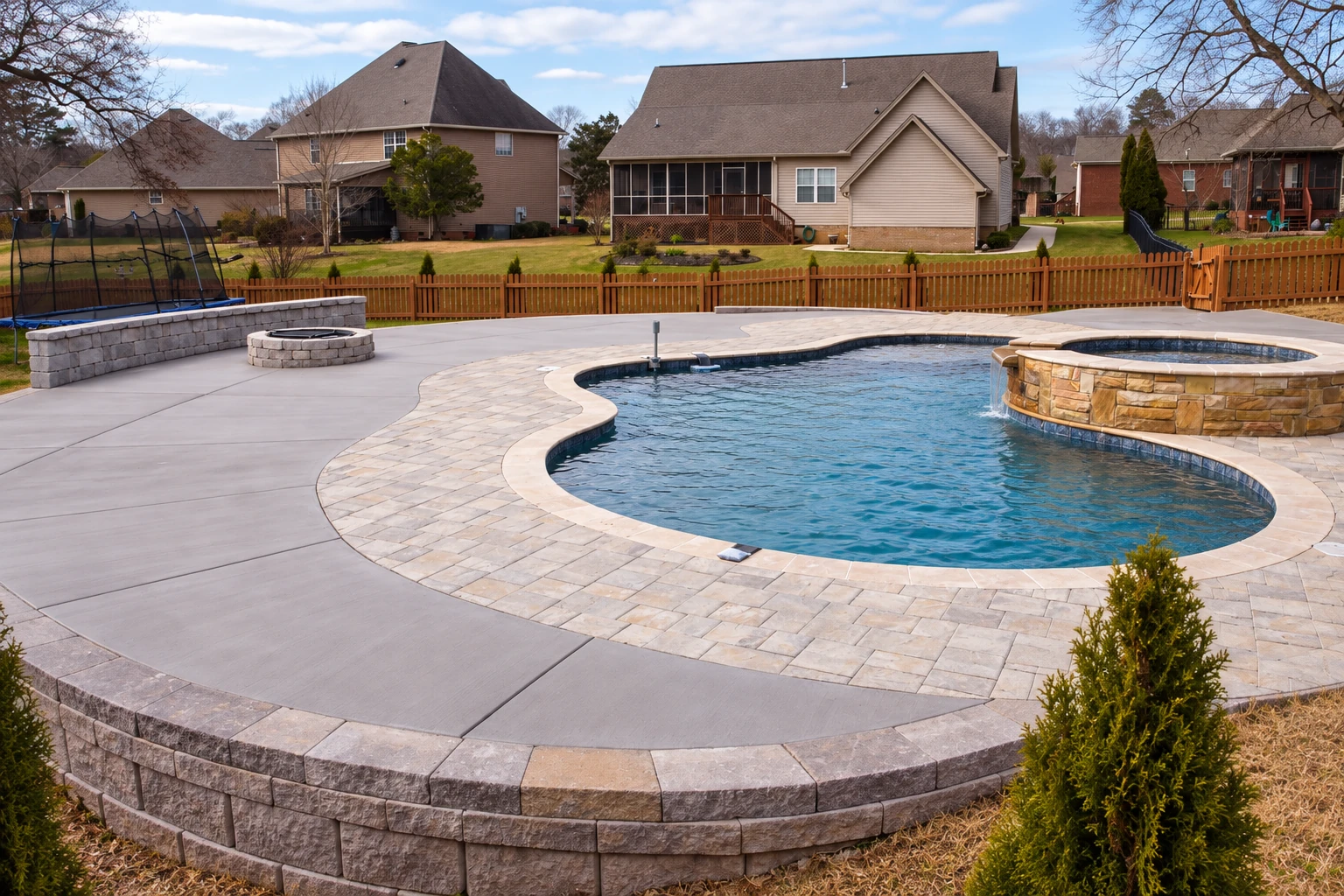
Concrete pool deck work in Chino Hills means forming, pouring and finishing the flat concrete around your pool, or laying a coating over the old deck when it's still sound enough to refresh.
I'll say the hard part first. Concrete cracks, but a deck that's cracked, stained or too hot to stand on doesn't always need to come out. Most of our calls come from homeowners in Chino Hills and the cities around it who want to know which kind of deck they have before they spend anything.
The price moves with the deck's size, whether we're coating the old slab or breaking it out, how easily we can get into your backyard and the finish you choose. The schedule turns on curing, the wait while new concrete hardens before you walk on it, plus the weather and a permit if your job needs one, which we handle for you. Your written estimate spells out what's included and what isn't.
I look at each deck and write the estimate myself, then a crew lead and our crew do the work while I stop by, so the person who saw the problem keeps an eye on it.
If your deck can't be saved, or a cheaper fix won't hold up, you hear it at the estimate, because I'd rather say it up front than have it come up halfway through.
Flatwork, the flat concrete like decks, patios and driveways, is its own licensed trade in California, covering forming, pouring and finishing. We're licensed and insured and backed by our satisfaction guarantee.
First I check whether your old deck can be resurfaced, because pouring new isn't the only answer and tearing out sound concrete throws away something you already paid for. If you go with a coating, we talk about color for heat and grip for wet feet before you choose, since those two decide how the deck feels on a hot afternoon more than the look does.
If it has to come out, we break up the old deck and haul it off, then dig out and pack the subgrade, the ground the slab sits on, so it doesn't settle later with loose dirt. We check where the water runs so the new deck sheds it away from your house, pour outside the hottest part of the day so the top doesn't come out weak and dusty, and cut control joints, shallow grooves that give the slab a straight line to crack along instead of wherever it likes. A broom finish, the light texture you see on most decks, gives wet feet something to grip, and then the slab cures before anyone uses it.
Here's the trade-off I name at every kitchen table. Nobody sees the base on day one, so it's the first thing people want to cut, and it's the last thing I'd cut, because a nice finish on a bad base can crack and sink and the only fix is tearing it out. That goes for the concrete steps down to the deck and for every slab foundation we build.
When sections have dropped or broken apart, a coating won't fix it, because the trouble is underneath. That usually means tearing out, rebuilding the base and pouring new concrete.
Puddles that stay on the deck or run toward the house mean the slope is off. A coating can't change the slope, so those sections usually need to be replaced.
One electrical trade article explains that paved concrete within 3 feet of the pool's inside wall is required to be bonded, tied in electrically, with reinforcing steel. Ask any crew how they handle that.
Adding onto an existing deck puts new concrete right next to old. We plan a joint where they meet so the two slabs can move separately instead of cracking across the seam.
Send the form and we'll get back to you within one business day to set a time. I'll come out, look at the deck and write the estimate myself, free and with no pressure to book.
Give us the square footage, or just the length and width, so I can get a feel for the size of the job before I come out to see it.
Shots of cracks, stains, low spots and the steps help me tell whether resurfacing is likely on the table, so the visit can go straight to your options.
Tell us if it's a salt pool, because that changes how we talk about sealers and upkeep for the concrete that sits around it.
Example photos of broom, coated and stamped finishes, plus deck and step layouts, to give us something to point at when we talk.
Straight answers on cost, resurfacing, permits, heat and sealers, the things people ask most before they spend money on a deck.
An installed concrete pool deck in the Inland Empire usually runs about $5.50 to $13 per square foot, counting materials, labor and site prep. That's the area's going rate, not our quote. Your written estimate shows where your deck falls and lists what's included and what isn't.
Often, yes, if the existing concrete is a good candidate. Resurfacing lays a coating over the old slab, and it's a cost-effective way to refresh a deck and fix its imperfections. A deck that's sunk or broken apart usually isn't a candidate, so I check the slab at the estimate before we talk coatings.
Building permits in Chino Hills come from the city's Building and Safety Division, which requires them for residential construction, including adding, altering, repairing or demolishing a structure. If you're not sure your deck falls under that, the city asks you to call (909) 364-2780. When a job needs a permit, we file the application and set up the city's field inspections.
Pick the color with heat in mind and ask about a slip-resistant additive. One coating maker says its cool-feel coating lowers surface temperature compared with bare concrete, by an amount that depends on color, air temperature, time of day and direct sun. The same maker warns coated surfaces may be slippery when wet, and some need that additive for safety.
An acrylic sealer lasts 1 to 3 years depending on the product, according to an older Concrete Decor article that says they're made to wear off and be reapplied. The same article quotes a preference for penetrating silane or siloxane sealers on pool decks, which soak in and leave no film, and reports salt system makers recommend a fresh water rinse after each use.
We're open until 10 PM on weekdays and 9 PM on weekends, so call (909) 308-0181 or send the form after work.